
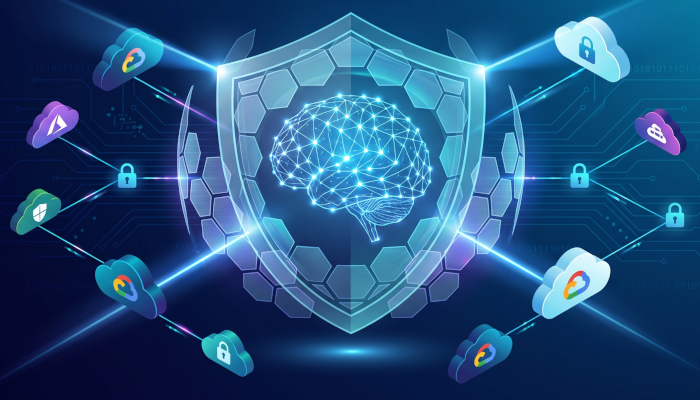
Cloud computing and artificial intelligence are converging fast, and the threat landscape is shifting right along with them. Anthropic recently previewed a powerful new AI model, Mythos, alongside a dedicated cybersecurity initiative; a critical vulnerability surfaced in the “OpenClaw” platform (CVE-2026-33579, CVSS 8.1-9.8); and the OWASP GenAI Security Project rolled out significant updates. Together, these developments make a strong case for cloud security architects to adopt vendor-neutral, portable security architectures that span both worlds.
Here, we break down the technical implications of these developments and offer architectural patterns and practical guidance for experienced cloud security professionals building resilient, future-proof security programs.
The AI Security Nexus: Opportunity, Peril, and Foundational Guidance
Highly capable generative AI models like Anthropic’s Mythos, with its emphasis on a cybersecurity initiative, are opening up real opportunities on the defensive side. These models are already useful for:
- Automated Threat Detection: Identifying subtle anomalies, correlating disparate security events, and predicting attack patterns at scale.
- Vulnerability Analysis: Automatically scanning codebases, identifying potential exploits, and even suggesting remediation.
- Incident Response Augmentation: Accelerating triage, root cause analysis, and playbook execution by processing vast amounts of telemetry data.
- Security Posture Management: Continuously assessing configurations, identifying drift, and recommending hardening measures.
But that same capability comes with real risk. Deploying advanced AI in critical infrastructure opens up a new class of attack vectors, and the security implications run deep:
Prompt Injection and Jailbreaking: Adversaries craft malicious inputs to bypass safety mechanisms, extract sensitive training data, or manipulate model behavior. This can lead to unauthorized information disclosure (e.g., exfiltrating PII used in training), denial of service, or even remote code execution if the AI system is interconnected with privileged functions. Mitigations involve robust input validation and sanitization, contextual understanding, privilege separation for AI agents, and output filtering. Guardrails implemented at the API gateway layer or within the inference service itself (e.g., using a smaller, specialized guardrail model) are critical.
Data Poisoning and Model Integrity: Malicious actors can introduce subtly corrupted data into training pipelines, leading to biased, compromised, or exploitable models. This can manifest as backdoors, reduced accuracy on specific inputs, or even Trojan attacks where a specific trigger phrase yields a predictable, malicious output. Architecturally, this necessitates secure, auditable data ingestion pipelines, strong data provenance, anomaly detection on training datasets, and federated learning approaches with differential privacy to protect individual contributions.
Model Exfiltration and Intellectual Property Theft: Highly valuable trained models can be exfiltrated through compromised API keys, side-channel attacks, or by exploiting vulnerabilities in the underlying infrastructure hosting the model. Mitigation requires stringent access controls on model artifacts (weights, configurations), network isolation for training and inference environments, encryption at rest and in transit for all model components, and continuous monitoring for unusual data egress.
Adversarial Attacks: Crafting inputs that are imperceptible to humans but cause the model to misclassify or generate incorrect outputs. This is particularly dangerous in security contexts where an attacker could, for example, subtly alter malware to evade AI-powered detection. Defense mechanisms include adversarial training, robust model architectures, and input feature verification.
The OWASP GenAI Security Project’s recent update and new tools matrix couldn’t be better timed. This project provides a vendor-neutral, community-driven framework to identify and mitigate the top risks associated with generative AI systems. For cloud security architects, integrating OWASP GenAI principles means:
- Shifting Left for AI: Incorporating AI security considerations into the entire MLOps lifecycle, from data collection and model design to deployment and continuous monitoring.
- Secure MLOps Pipelines: Automating security checks within CI/CD pipelines for model code, dependencies, and infrastructure-as-code (IaC) templates defining AI environments. This includes static application security testing (SAST) for model code, container image scanning for inference environments, and policy-as-code enforcement (e.g., using Open Policy Agent) for model deployment configurations.
- Robust Data Governance: Implementing granular access controls (leveraging cloud-agnostic IAM principles like OIDC/SAML federation), encryption, data lineage tracking, and compliance frameworks for all data used in AI training and inference.
- Secure Inference Endpoints: Protecting AI APIs with dedicated API gateways featuring authentication, authorization, rate limiting, and sophisticated input validation/output sanitization beyond traditional WAF capabilities. These gateways should integrate with real-time threat intelligence and potentially even specialized AI-powered security modules.
The Enduring Challenge of Platform Vulnerabilities: Lessons from “OpenClaw”
While the AI frontier expands, the underlying cloud platforms still need to be locked down just as tightly. The “OpenClaw” platform’s CVE-2026-33579 (CVSS 8.1-9.8), exploitable from a low-privilege access point, is a reminder that persistent, critical vulnerabilities in the ecosystem haven’t gone away. It’s a common pattern: a seemingly low-privileged access vector enabling high-impact compromise.
From a technical perspective, a low-privilege entry point leading to such a high CVSS score typically indicates:
- Authentication Bypass or Weak Defaults: A flaw in the authentication mechanism or an insecure default configuration allowing unauthenticated or minimally authenticated users to access sensitive functions.
- Insecure Direct Object Reference (IDOR) or Authorization Bypass: Even with basic authentication, a flaw allowing a low-privileged user to access or manipulate resources belonging to other users or higher-privileged processes by simply changing an object ID.
- Deserialization Vulnerabilities: Often found in APIs, these allow attackers to inject malicious objects into a serialized data stream, leading to remote code execution (RCE) without extensive privilege.
- Logic Flaws: Subtle errors in application logic that, when exploited, grant elevated privileges or expose sensitive data (e.g., a password reset mechanism that can be abused).
- Supply Chain Vulnerabilities: The “OpenClaw” platform itself might be a component within a larger cloud service, and its vulnerability could stem from an upstream library or open-source dependency, highlighting systemic risk.
The high CVSS score (8.1-9.8) implies significant impact on confidentiality, integrity, and availability, with low attack complexity. This translates to an urgent need for proactive defense. Cloud-agnostic architectural responses to such vulnerabilities include:
- Zero Trust Architecture: Assume compromise and verify everything. For OpenClaw-like vulnerabilities, this means enforcing microsegmentation between all services, even those within the same virtual network. Every service-to-service communication requires strong authentication and authorization, often implemented via service mesh (e.g., Istio, Linkerd) for mTLS and granular policy enforcement.
- Strong Identity and Access Management (IAM): Implement the principle of least privilege rigorously. Even “lowest-level” access should be severely constrained. Use attribute-based access control (ABAC) where possible, federate identities using OpenID Connect or SAML, and enforce multi-factor authentication (MFA) universally. Regularly audit and review IAM policies, ensuring no overly permissive roles or stale credentials exist.
- API Security Gateways: All external-facing APIs, and ideally internal APIs, should be fronted by robust API gateways. These provide a layer for input validation, rate limiting, schema enforcement, authentication, and authorization before requests ever reach the underlying service. Modern API gateways can also integrate with Web Application Firewalls (WAFs) and Runtime Application Self-Protection (RASP) capabilities for deeper threat detection.
- Automated Vulnerability Management: Continuous scanning of all infrastructure components, including virtual machines, containers, serverless functions, and managed services. This includes dependency scanning (using tools like Trivy or Snyk) for third-party libraries within deployed applications, as well as configuration compliance checks (using tools like Cloud Custodian or Open Policy Agent).
- Immutable Infrastructure and Ephemeral Resources: Deploying infrastructure via IaC ensures consistency and reduces configuration drift. Leveraging ephemeral resources (e.g., containers, serverless functions) means that if a component is compromised, it can be quickly replaced with a known-good instance, limiting the attacker’s dwell time.
Bridging the Divide: A Unified Cloud-Agnostic Security Strategy
The convergence of advanced AI and cloud platform vulnerabilities necessitates a unified, cloud-agnostic security strategy. These aren’t disparate problems; an AI model (Mythos) might be hosted on a vulnerable platform (OpenClaw), or an AI could be used to discover and exploit platform vulnerabilities.
Core Cloud-Agnostic Principles for a Unified Defense:
Security-by-Design and Shift-Left Across the Board: Embed security into every stage of the software development lifecycle (SDLC) and MLOps pipeline. Leverage IaC (e.g., Terraform, Pulumi) to define secure cloud environments, and policy-as-code (e.g., OPA Gatekeeper for Kubernetes, Sentinel for Terraform Enterprise) to enforce configurations and IAM policies pre-deployment. Adopt OWASP GenAI principles from the outset for AI systems
Robust Attack Surface Management: Continuously map and reduce the exposed surface area for both traditional cloud resources and AI components. This involves regular asset inventory, network segmentation (VPCs/VNets, subnets, security groups, network ACLs), and ensuring that only strictly necessary ports and protocols are open. For AI, this extends to securing inference endpoints, data lakes, and model registries.
Zero Trust Principles for All Workloads: Apply granular access controls and microsegmentation universally. Every interaction, whether human-to-machine, machine-to-machine, or AI-to-data-store, must be authenticated, authorized, and continuously verified. Implement service meshes to enforce mTLS and policy on internal API calls, including those to AI services.
Continuous Security Validation and Observability: Implement a comprehensive suite of security testing: SAST, DAST, IAST (Interactive AST), fuzzing for applications and AI models, and regular penetration testing. Beyond traditional monitoring, employ advanced logging, tracing, and metrics for AI systems to detect prompt injection attempts, data drift, and adversarial attacks. Utilize security information and event management (SIEM) and security orchestration, automation, and response (SOAR) platforms to correlate alerts from both cloud infrastructure and AI runtime.
Supply Chain Security Extended: Vet all third-party components, libraries, and managed services for vulnerabilities. This now extends to pre-trained AI models, datasets, and even the toolchains used in MLOps. Implement strong software bill of materials (SBOM) generation and integrity checks for all deployments.
Architectural Patterns and Implementation Guidance:
Secure AI Model Deployment Pipeline:
- Data Ingestion Layer: Utilize secure object storage (e.g., S3-compatible, Azure Blob Storage) with encryption at rest and in transit, private endpoints, and strict IAM policies. Implement data loss prevention (DLP) for sensitive training data.
- Training Environment: Isolated network segments (VPC/VNet subnets), containerized training jobs (Kubernetes, serverless containers) with minimal permissions. Leverage confidential computing if available, to protect data in use.
- Model Registry: Version-controlled, immutable storage for trained models, secured with strong access controls and integrity checks (e.g., cryptographic hashes).
- Inference Endpoints: Fronted by an API Gateway with mutual TLS, OIDC/SAML integration for authentication, token validation, fine-grained authorization, and WAF capabilities. Implement input validation, prompt filtering, and output sanitization within the inference service itself, with robust logging.
- Monitoring & Feedback: AI observability platforms (open-source or commercial) to detect model drift, adversarial inputs, prompt injection attempts, and performance anomalies. Integrate with security alerting systems.
Resilient Cloud Platform Hardening (Mitigating OpenClaw-like Flaws):
- Network Segmentation with Policy-as-Code: Define network ACLs, security groups, and microsegmentation policies via IaC. Use OPA with Gatekeeper for Kubernetes or cloud-native policy engines to enforce network separation and traffic rules.
- Fine-grained IAM for Service-to-Service Communication: Use service accounts with minimal permissions. Implement managed identity services or workload identity federation to eliminate hardcoded credentials.
- Automated Configuration Drift Detection and Remediation: Continuously monitor cloud resources against desired state configurations defined in IaC. Tools like Cloud Custodian can identify and automatically remediate non-compliant resources.
- Runtime Threat Detection: Deploy host-based intrusion detection (HIDS) like Falco (using eBPF) or osquery for real-time threat detection within containers and VMs, specifically looking for process anomalies, unauthorized file access, or network egress indicative of compromise.
Trade-offs and Enterprise Adoption
Implementing these comprehensive, cloud-agnostic strategies involves significant trade-offs. The complexity of managing interwoven security controls across diverse cloud services and AI systems can lead to increased operational overhead. Performance impacts, particularly with heavy encryption, detailed logging, and AI-powered security features, must be carefully balanced against security posture. Moreover, the skill gap in cloud-native security and AI security is pronounced, necessitating continuous training and upskilling of security teams.
Enterprises should adopt these principles iteratively, prioritizing critical assets and high-risk areas. Start with foundational controls like strong IAM, network segmentation, and IaC for security, then progressively integrate advanced AI security and runtime protection mechanisms. Fostering a strong DevSecOps culture that empowers developers with secure patterns and automates security guardrails is essential to making this work at enterprise scale.
Conclusion
The convergence of powerful AI and critical cloud platform vulnerabilities calls for a proactive, cloud-agnostic security strategy. By embracing security-by-design, continuous validation, Zero Trust principles, and community-driven guidance like the OWASP GenAI project, organizations can build architectures resilient enough to protect both their AI assets and their underlying cloud infrastructure. Get the fundamentals right; portable, vendor-neutral patterns that hold up regardless of provider… and you’re prepared for whatever comes next on either front.
References
This article was informed by the following sources:
- Anthropic debuts preview of powerful new AI model Mythos in new cybersecurity initiative – TLDR Infosec
- OpenClaw gives users yet another reason to be freaked out about security – TLDR Infosec
- OWASP GenAI Security Project Gets Update, New Tools Matrix – TLDR Infosec
Additional Resources
About
With over 25 years in the technology sector, Keith has spent the last decade providing consultancy, support, and strategic direction to customers across multiple cloud platforms.



Disclaimer: The information shared on this blog is for informational purposes only and should not be considered as professional advice. The opinions presented here are personal and independent of any affiliations with tech companies or organizations.